

By Ron Kemprai
Early part of life:
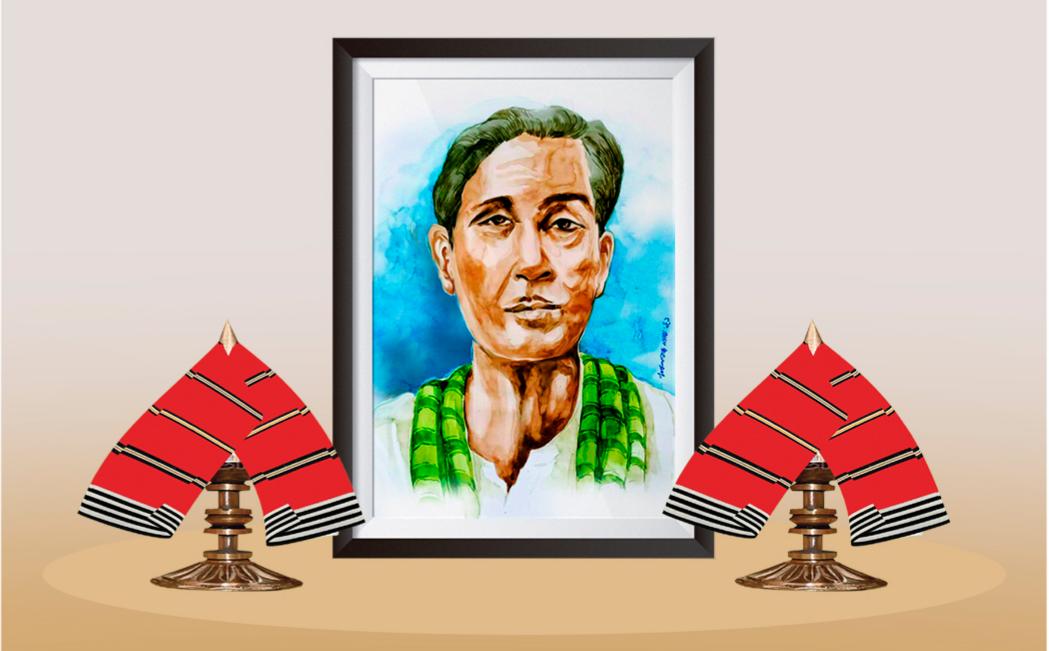
Sombhudhan Phonglo was born at dawn on 12th March’ 1850 in the tiny village of Lonkor, near the ancient temple of Goddess Ranachandi of the Dimasa Kachari Kings at Maibang in the Dima Hasao.. The day was Phalgoona Purnima as per Indian almanac. His father was Depronao Phonglo and mother Kasaidi Phonglo, who had five sons namely Sombhudhan, Umakant, Ramakant, Ramcharan, alies Ramen and Haisholong. Amongst them Sombhudhan was the eldest and Haisholong was the youngest. He spent his childhood at Longkhor. His parent was shifted to Gungjung in 1860 (aprox) and then again shifted to Saupra, a small village near Nanadisa. His parents again left this village and went to Semdikhor (Present Dihorphonglo village near Dautohaja Rail Station). While he was there at Semdikhor, he got married to Nasadi, daughter of Santudao Naiding, the village head. Sombhudhan dug a well there nearby the Moti-Nala, which name is presently identified as Sombhudhan ni Dikhor. History of Kachari Kingdom by Dr. S.C Goswami
Sombhudhan was a devotee of Sivarai. He was found much inclined to lord Siva since his childhood. He professed that Siva should be adored as the root of the three stages of creation, preservation and destruction of the universe. Every day, Sombhudhan used to worship the Lord Siva and meditate at a place named Gragong, sitting in padmasana on a large rock in the river of Diyung. Every day, after returning home, he attended a large number of people who came to meet him. Surprisingly he grasped indigenous knowledge on traditional medicine to cure many diseases and ailments. He appointed Desain Kemprai for assisting him in collecting herbs, shrubs from jungle which can be used as medicines. He cultivated many wild plant in his village and kept them in the form of herbarium and stored them for future used. His name and fame spread and people from many corners came to him with many hopes. People look upon him as theosophist and curer of ills. (Oral note of Gumidon Kemprai in 2006 of Longma near Haflong.)
Revolt against whites (British):
The British annexed Southern part of Dimaraji i.e Dimasa-Kachari Kingdom of Cachar in 1832. But the hills Division of Dimaraji, comprising the north of Cachar, Dayung Valley, Khopili Valley and Dhansiri Valley including the ancient capital Dimapur, “the Brick City” of Dimasa-Kachari Kingdom (1015-1535 A.D) was retained and held by Tularam, the General of the King of Cachar. But after the death of Tularam, the hill Division was annexed by the British in 1854. Subsequently, in 1866, different parts this territory like Dayung Valley, Khopili Valley had been merged to the district of Nowgong and Dhansiri valley and part of North Cachar was merged with newly created District, Naga Hills. The rest formed the North Cachar hills comprising exclusively the hilly region.
Sombhudhan was not happy with the divide and rule policy of the British, which was intended to weaken the native people. He could not console his mind that the white foreigners should rule the Kacharis of Dimaraji. Sombhudhan therefore decided to rebel against the British. He observed that although the British had annexed the territory but they were not able to conquer the heart of the native people. He therefore considered that everything was not lost. He resolved to prepare for a last-ditch battle.
Sombhudhan toured extensively in the North Cachar Hills for mass contact and organisig people. He recruited a large number of youths to form revolutionary force against the whites. He was in search of his Principal Adviser and Subordinate Commander to look after his force. He appointed Mansingh Kemprai as Principal Adviser and Molonthong Thaosen as subordinate Commander and established his training camp at Maibang near the Goddess Ranachondi Temple. For smooth functioning of his training centre at Maibang, Sombhudhan had to meet a considerable amount of expenditure; he therefore collected levy from the local people. The increasing activities of Sombhudhan had caused to be a great concerned to the British, and which bound to the British to deal with firm hands on the charge of revolting against the Sombhudhan’s group. The Sub-Divisional Officer of North Cachar had issued summons to Sombhudhan and his Principal Adviser Mansingh Kemprai and subordinate Commander Molonthong Thaosen. But they did not care to appear before him. On further advice from the Deputy Commissioner, a warrant of arrest was issued by the Sub-Divisional Officer and dispatched a police-force under a police officer for apprehension of the Sombhudhan and his group. But the officer failed to execute the order and came back with a letter from Sombhudhan.
The letter was written by Mansingh on being dictated by Sombhudhan in the following format
You whites bubble
If you have any desire for food
To eat on this earth,
And
If you have any desire for water
To drink on this earth,
You should leave our kingdom
Before I reach you (at Gunjung)
No army would induce Sombhudhan
To appear before an illegal authority
And
Any army despatched to Maibang
Would be completely annihilated.
Mr. Soppi, who held the charge of SDO, considered that the situation of the Sub-Division is going to deteriorate and therefore he met Deputy Commissioner, Major Boyd at Silchar. They crushed the movement almost brutally. Therefore, in January, 1882, the Deputy Commissioner, accompanied by the Sub-Divisional Officer, marched to Maibang with a contingent of 25 Frontier Police.
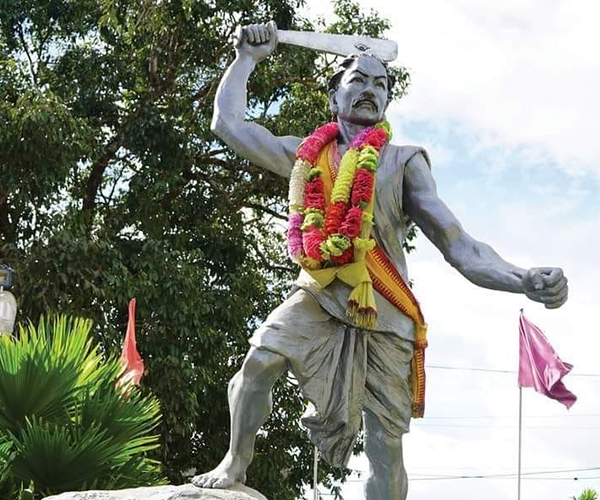
Sombhudhan was quite aware of probable attack by the British at any moment. Therefore, he had alerted his men before-hand that should outside force visit Maibang. The Major Boyd and his party reached Maibang in an afternoon. On next day, they marched to the Sombhudhan Camp in the early morning. Strangely he found no man there, only the scattered huts of Sombhudhan’s cadres on the top of the hills. Suddenly, after few moments the alarm rang and men of Sombhudhan rushed from the surrounding hills equipped with double edges swords. Major Boyd alerted his force and ordered not to fire until hard-pressed. Sombhudhan came out from one side of the hills followed by his men and marched toward Major Boyd. As he came closer the security of Major Boyd stood in between them, but Sombhudhan fearlessly struck the security guard with his sword which glanced off his riffle causing his instant death, and Major Boyd also at the same time lost his right arm, which resulted in his fatal death. Whereupon, Mr. Soppit, SDO, had taken charge and ordered them to fire. As firing was commenced, Sombhudhan’s cadres from surrounding attacked them. Finally Mr. Soppit, the SDO, had lost the battle. More than 20 sepoy men had been killed. Luckily some of the sepoy managed to escape from there, and returned to Gunjung with death body of Major Boyd. The success of Sombhudhan in killing of Major Boyd and his force has made him to claim the title of “Vir”. Oral history cited by Himkant Phonglo of Sampari village the victory of Maibang battle encouraged and inspired Sombhudhan and he planned to attack the Sub-Division, North Cachar, headquarter at “Gunjung”. On reaching Gunjung they killed two horses of SDO, and burnt all the Government buildings and documents of the Sub-Division office. The British had to temporarily shift their office to Silchar. Finally, as a result of the incident, the Briish Govt. shifted their Sub-Division headquarter from Gunjung to Haflong in the year 1898.
Having being successful in driving out the British from the hills, Sombhudhan now turned to the plain of south Cachar to organise similar movement against the British rule there. There he then contacted Uzir Dibragede, an ex-army commander of last the Dimasa Kachari King, Raja Gobinda Chandra of Cachar. He collected iron with the help of his followers and gathered huge amount of donation from the villager, in order to make a weapon to fight with British. Sombhudhan had visited many Siva Temples established by the Dimasa-Kachari Raja of Cachar and he also built a Siva Temple at a place east of Sadagram and installed Mahadeva therein. Therefore, the place had been known as Mahadevapur.
In the meantime, the British Government got information of Sombhudhan’s organisational works in the plains near Silchar. The British made a policy to catch Sombhudhan alive from his house and arranged a woman “Rangsiringdi” to make friendship with his wife. One night this woman stayed in his house with the intention to remove his arms from his house. In the morning, he found no arms in his house to defend himself and his house was cordoned by British force. Immediately he started running toward the jungle. While he was running a British sepoy threw his Khukri at him and it made a deep cut on his right leg. Still he continued on running and went to the jungles of Bhuban hills. He became weaker and weaker due to profuse bleeding. At last he was caught by the British force after 2 days of the attack on him. Sombhudhan took his last breath on 12th February’1883. Sombhudan, thus died a death of a martyr at a small and unknown place beside a spring near Igraleing in the North Khaspur locality. After his body was brought to the headquarter at Silchar, a police force was sent to bring Vir Sombhudan’s wife, Nasadi. But she was not there in the village. His old mother Kasaidi had received the death body of Vir Sombhudan.
After a year, Mansingh Kemprai, the Principal Adviser of Sombhudan was arrested in Tripura and brought to Silchar; and sentenced to penal servitude for life. There he fasted unto his death in the Silchar district jail. Desain Kemprai, the well known herbalist and Gadao Kemprai, were settled down at Sadagram, near the Snan-Gat.
Living blood relation of Sombhudan:
After the death of Vir Sombhudan, his wife Nasadi and daughter Dauridi were taken by relatives to the village Longma near Haflong. Dauridi got married with Mohendra Dibragedea resident of the village Phaiding near Dautuhaja Railway station.
(The author of this article is a MSc, MPhill, PGCAP, DDT and is presently working as a Lecturer in Haflong Govt. College, Haflong, Dima Hasao)