


By Raj Kumar Keche
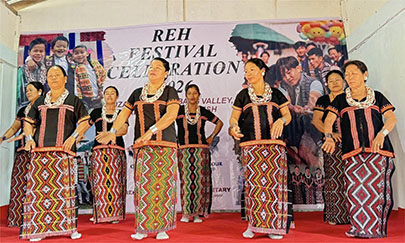
Reh is the most important festival of the Idu-Mishmis of Arunachal Pradesh. The etymology of the word ‘REH’ carries the meaning ‘Invitation’. The purpose is to attain happiness and prosperity by appeasing the tutelary spirits commonly known as ‘Nani Ini Taya’, ‘Maselo-Jinu’ and ‘Asile-Amide’.
Reh celebration consists of the following five days:
1. 1st day (Andropu)- On this day ‘Igu’ (Priest) arrives to carry out the act of ‘Meye-Aji’ which is a ritual for the well being of all the guests or ‘Meye’. In the meanwhile the guests and the invitees keep arriving in batches from different distant places. Female relatives of the ‘Mengga’ or the host come with presents or ‘Agite’. Also on this day potential Reh hosts offer ‘Ada’ or loan and the hosts repay their loan in the form of ‘Ada-Da’, The host villagers greet the guests with a chorus cry of ‘Mye-Bo’ in a repeating pattern.
2. 2nd day (Eyanli) - The second day also called as ‘Sa-che-Machinyi’ is the day of the sacrifice of the animals. The Igu performs the ritual ‘Sa-acha’, an act of purifying the animals. On this day the host presents ‘Emeta’ or gifts in the form of cash to relatives of his wife and mother. Live pigs are offered to maternal uncles, brother in –laws and father in –law. The fee of the Igu in form of live pig is given on this day.
3. 3rd day (Eyinli) - The third day is significant for the pigs. The cousins of the host receive head of sacrificed pigs as a mark of respect. The female relatives and donors of ‘AGITE’ are gifted with ‘AGIRO’ or a bundle of dried fish and wild rats.
4. 4th day (ILLIRUMUNYI)- on this day most of the guests from distant and far off place depart. The evening is marked by a especial ritual of ‘Apesa Adegi’ in which two males dressed as a couples enact a mock sexual act and apply a charcoal paste in the faces of all present. This ceremony performed to appease the goddess ‘Apesa’, holds a significant place as it is believed that it bring it brings health and prosperity.
5. 5th day (Awruhaa/ Awrugoo) – Also known as ‘Etonu-Che’ this is this concluding day. The priest or the Igu’s early departure in the morning indicates the conclusion. Fowls are sacrificed for appeasing the goddess ‘Apesa- Aduyu’ for abundance in crop harvests. After the completion of Reh the hosts observe a ten days taboo.
The festival is basically an individual affair where a husband and wife is the host. As is expected and Idu person aspire to host the festival once in life time. Modern constraints do not permit the fulfillment of such aspirations hence everyone cannot host the individual festival and therefore the concept of ‘Community Reh Festival’ celebrated every year on the 1st, 2nd and 3rd day of February has been embraced by all. Initialed by late Ita Pulu in the year 1968 the first community Reh took off with great enthusiasm and has till date retained it universal character and appeal.
Hosting the individual Reh requires a good amount of planning, something a lifetime planning and an exceptional organizational capacity. Important preparatory events before the onset of the Reh festival can be listed as follows:-
1. Ada:- It is the act in which an Idu person undertaking the preparations of Reh offers loan to the hast of an ongoing Reh. The later has to repay it during the Reh of the former which is called Ada-da. The loan can be in case or kind.
2. Hathru:- If a person has prepared and decided to host a Reh then he declares it by performing ‘Hathru’ whereby at least a mithun is sacrificed. Once declared the Reh festival has to be hosted within that year.
3. Mrano-che:- After the declaration one starts clearing the jungles for cultivation which is called ‘Mrano-che. All the co-villagers are obliged to help as the products of this cultivation is exclusively utilized during the Reh festival.
4. Reh-Igu-Che:- The contract of the priest or Igu is sought for performing the rituals before the Reh. This is a very significant event as the priest or the Igu is the one who will play the pivotal role during the Reh.
5. Hawe-angi:- This is the occasion for husking paddy, grinding rice and millet. At least on month before the commencement of Reh womenfolk take part in crushing rice, maize and millet for preparation of food stock.
6. Yu-phi:- on this day varieties of rice beer or ‘Yu’ such as ‘yu-nyi’, ‘Yu-yu’, ‘Yu-nu’ and ‘Yu-andro’ are prepared. One mithun and a pig are sacrifice as village feast. This is don one –two month prior to the onset of food stock.
7. Tayi-La: - Invitation is sent through a ‘’tayi’, which is a threat made of tree bark. The ‘’tayi’ a number of knots denoting the number of days left for the celebration of Reh. On receiving a ‘tayi’ a knot is cut off with each passing day. The last two knots remain as they represent the start of Reh.
8. Adaso:-It symbolizes the final preparations. On this occasion a ‘chang’ is constructed in front of the house adjoining the veranda. This is where all the guests and the invitees will be received and ‘Ada’ recorded. This construction is done five days before the Reh festival begins.

