

By Dayananda Pathak
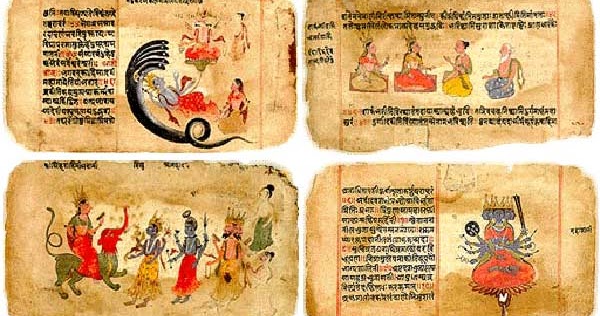
About the colour and contour of Vedic literature the scholars all across the world appear to be intoxicated. The entire corpus of what we call Vedic range of literature is the autobiography of Indian thought and perceptions of life and living. The word ‘Veda’ is rooted to Sanskrit word ‘vid’ (to know).Thus the general meaning of Veda is construed to be knowledge or consciousness. In other words, Veda means the unending storehouse of knowledge and wisdom- both material and spiritual. Veda is a gigantic range of ancient literature. It cannot be ascribed to any single author or group of likeminded authors. Such writings are considered to be divine revelations. So they are called Apaurusheya, i.e., not being composed by any individual human hands. They are handed down from generation to generation in diverse forms. Such writings are also described as nitya, that is, permanent and eternal. It is, however, a fact that our ancient sages composed them under the direct inspiration from some divine authority.
Some scholars hold the opinion that the process of writing came much later. The composition of the Vedic hymns took place much earlier, and they existed in the form of shruti (hearing) and smriti (remembering), handed down from generation to generation as a holistic legacy.
There are different views regarding the time of composition of the Vedas. A group of scholars hold the opinion that the Vedas were composed during 3000- 2500 BC. While another section holds the view that the sacred books are written 5000 years BC. We, however, have the feeling that the opinion of such scholars have some truths and supportive reasons. A single year or century cannot be fixed for Vedic literature. This must also be borne in mind that Vedas are the literary expressions of varied colors, composed in different times of Indian civilization. Scholar like J. Hartel believes that Rig-Veda must have originated in Iran, and not in India. Such views and observations have considerably mystified the Vedic period and the literary manifestations of the period.
Vedic literature is stated to have three major periods. The first period refers to the Samhitas. The second period refers to the Brahmanas. The third period refers to the Upanishads, Aranyaks, and Sutras. All the three taken together constitute the vast expanse of Vedic literature. Samhitas refers to the bare texts of the four Vedas – Rig-Veda, Samveda, Yajurveda and Atharvaveda. The structure and the volume of each Veda is well designed to suit the contents. For example, the Samhitas of Rig-Veda has about 1000 or 1028 hymns. They are arranged into ten mandalas (chapters), depending upon the name of the sages who composed them. Such mandalas are also arranged on the basis of the subject matter.
The Samhita of Samveda has 1810 hymns. It is often described as a book of chants, meant to be chanted at the time of Soma sacrifices. Barring only 75 hymns the rest of the hymns are stated to have been drawn from Rig-Veda Samhita. Musical elements tend to make Samveda is quite interesting to a special class of people. It narrates how sacrifices are to be performed. Atharvaveda is often considered to be an extension of the Rig-Veda. One can notice close resemblances between the two Vedas. Atharvaveda contains hymns meant for the control and taming of the evil spirit and demonic powers. It is structured into 20 books with 73 hymns.
Samhita period is followed by the Brahmana period. This phase is marked by its own distinct features. The Brahmanas are commentaries on different hymns. They also explain the significance of sacrifices and about the ways of their performances. Each Brahmana is basically an extension of the Samhita. Say for example, scholars point out that Aitareya Brahmana and the Kanshitaki Brahmana relate to Rig-Veda Samhita. Whereas jaiminiya Brahmana, Tandya-Maha-Brahmana and Sadvinsa Brahmana relate to Samveda Samhita. The Sadapatha Brahmana is connected to Yajurveda Samhita. Similarly, Gopatha Brahmana relates to Atharvaveda Samhita. Such Brahmanas make exhaustive narration about sacrifices and ways of making them. Apart from that some of the Brahmanas speak volumes about the cultural and social life of the non-Aryans. How a non-Aryan could be Aryanised is also being explained in some of the Brahmanas. These Brahmanas narrate the specific functions of the specific class of priesthoods, such as Hotri priests, Udgati priests, Adhvaryya priests and so forth. In fact, specific performance is fixed on specific class of priests.
The Brahmanas, although considered to be an integral paret of the Vedic literature, they are often looked down upon as mere non-sense by a group of scholars. Max Mueller considered them to be mere ‘theological twaddles’1. Again, according to Dr Winternitz the Brahmanas constitute an important segment of Vedic literature. The general readers may not enjoy the Brahmana part of the Vedic literature. But they are considered to be important social documents of the Vedic society and civilization.2
Aranyakas, considered to be ‘forest books’, makes the summing part of the Brahmanas This part deals with what may be described as mystic philosophy, specifically covering the sages engaged in serious contemplation in the deep forests, away from the mundane part of human life. The ritualistic part of life is detached in the Aranyaks.
The Upanishads virtually strikes the culmination of the Vedic literature in terms of philosophical and spiritual musings. The thoughts embedded in the pages of the Upanishads mark a significant leap-forward in the history of man’s spiritual journeys. According to Schopenhauer, the great German philosopher, every sentence of the Upanishads is “deep, original, and sublime thoughts arise, and the whole is pervaded by a high and holy and earnest spirit. Indian air surrounds us, and original thoughts of kindred spirits. And Oh, how thoroughly is the mind here washed clean...”3 He further said, “It (Upanishads) has been the solace of my life – it will be the solace of my death.”4
The philosophical exploration of life as adumbrated in the Upanishads, numbering 108, mark the zenith of human thought and spiritual consciousness of the highest order. Scholar like Will Durant compares Upanishads with New Testament of the Christendom.5. Not to speak of ordinary followers, even persons of eminence like Schopenhauer and Emerson also were deeply touched by the Upanishadic doctrines.6.
Dr Winternitz feels that the entire gamut of Indian philosophy is rooted to the Upanishadic doctrines. In his words – “In fact the whole of later philosophy of the Indians is rooted to the Upanishads. Their doctrines formed the foundation of the Vedantic sutras of the Badarayana.”7. He also refers to how sages like Sankaracharjya and Ramanuja got inspired by the philosophical doctrines enunciated in the Upanishads. All the philosophical systems of beliefs, developed in India at a later time are also found to be firmly rooted to the Upanishads. This Upanishadic ways of looking at life and universe have given a specific orientation to the Indian mind.
The Upanishads do not plead for a sky-high philosophy. It deals with all the practical and down-to-earth human truths of life. It pleads for a balanced life, wherein even the material aspects of life are also not ignored in preference to spiritual issues. Dr Winternitz further adds saying “The Upanishads do not contain superhuman conceptions, but human, absolutely human attempts to come nearer to the truth – and it is this which makes them so valuable to us.”8
The essence of the Upanishads covers the best elements of Sufism as developed in contemporary Persia, neo-Platonism of Greek civilization, and also partially to what we find in mystic Christianity. In fact, it anticipated the best parts of every human thought, subsequently projected by the different philosophical schools the world civilization ever produced.
The Upanishadic thoughts, however, took time to settle down. The Vedic hymns were considerably unsettled for historical and political reasons. From the Vedic thought pattern to its subsequent Upanishadic expressions, routed through Brahmanas and Aranyaks occupied a major space in Indian history. The growth of Indian thought, and every aspect of Indian civilization, is routed through Upanishadic systems of beliefs. In the language Amaury de Riencourt “The Upanishadic era represents the zenith of India’s cultural growth.”9. But over the past millennia we have not been able to surpass or equal the depth, height and width of the Upanishadic thoughts. Now we have the feeling that India had already enjoyed its best parts of life during the Upanishadic era.
The Vedic pattern of thought takes us to a world of joy and celebration of life. We began to learn that life can be enjoyed fully if we remain deeply attached to land, environment and natural human relationships. The Vedic pattern of thought has all been secular. It does not imply adherence to any specific religious order. But over the millennia we move on to the Upanishadic era and step into a world of new spiritual awareness that is crystallized in the Upanishads. We have begun to feel that mere celebration was not the be-all-and end-all of the Upanishadic teachings. We must also be in a position to have a ringside view of life. What life is all about? Where does it lead us to? What is the shape of truth beyond this apparent truth? These elemental questions of life began to emerge in Indian minds when a phase of maturity started taking shape through Upanishadic thoughts.
By the way, Upanishad implies ‘sitting near’ – meaning sitting together with truth. That was possible under the situation of nearness between the teacher and the taught directed towards spiritual communion. It is the communication relating to the secret (rahasya) of existence. It is the communication of truth relating to the creator (The Supreme being) and the created ones (being).
The Upanishad is not a single piece of composition by any single author. We have as many as 108 Upanishads authored by different sages covering a period from 800 BC to 500 BC. Every sage author had his own ways of looking at things. Since it is not a consistent whole, it requires a thorough and intensive study by the serious researchers. Nevertheless, we find a unifying cord that passes through all the 108 Upanishads. The unifying cord can be described by saying “The universe is the Brahma, while Brahma is nothing but atma”. In short, Brahma is nothing but God, while the soul within man is nothing but God. Thus the soul of every man is a reflection of the Supreme Being.
The idea of the universe in relation to man or any living being is being addressed by each of the 108 Upanishads in its own language and rhythms. The Upanishad tells us to assert our existence and also to negate it as and when situation so requires. Every man is advised to behave like Brahman and also as a child. Childlike innocence can lead us to a state of deeper realization that cannot be done by mere erudition. Frederick Nietzsche, the great German philosopher, also reflected on the quality of childlike innocence. The Supreme reality can be felt only under that blessed condition. One cannot go too far only by virtue of intellectual gymnastics as much as we can go by sheer childlike innocence and devotion. The Upanishad teaches us to internalize our knowledge. Only through this process of internalization and deep self-introspection we can feel the reality beyond the apparent reality. Our ancient sages are painted as lost in trance with their eyes and ears closed, and all their sense organs deactivated. They realized the truth of existence only through internalization of thoughts and feelings. The tragedy of ours is that we see ourselves as totally isolated beings. That we are already integrated with the soul divine is outside our normal perceptions.
The Upanishads believe in transmigration of soul. It is closely linked with the belief in rebirth. The soul is always in the process of migration, from one life to the other. This process is endless until the soul merges with the Supreme Soul. As and when the human soul gets released from the chain of births and rebirths the journey continues. Raja Janaka wanted to know from Rajarshi Yajnavalka how to get rid of the chain of births and rebirths. To this the Rajarshi replied that only by total surrender before the Lord and by liquidation of all material desires one could internalize his thought and get united with the Supreme Being. It is just as a river loses its identity as and when it meets the sea, a person loses his individual identity as and when he gets merged with the Supreme Being.
The entire gamut of Indian thought is rooted to this Upanishadic belief. After the Vedas we have the Vedangas. They are considered to be subsidiary Vedas. We have six very important Vedangas - Siksha, kalpa, Byakarana, Nirukta, Chanda and Jyotisha. Siksha deals with pronunciation of words, considered to be very sacred in Vedic literature. Kalpa deals with religious and social rites and rituals. Byakarana deals with grammar of the language, while Nirukta is concerned with meaning of words, i.e., etymology. Chanda covers rhythms and meters of a language. Finally, Jyotisha addresses the astronomical issues.
Then we have the Upavedas like Dhanurveda, Ayurveda, Gandharvaveda, Shilpaveda and so forth. Dharnurveda deals with the art of warfare. Ayurveda deals with medication. Gandharvaveda deals with music and fine arts. Shilpaveda deals with art of construction and architecture.
The domain of Vedic literature also includes six darshanas. They mean six schools of philosophy. They are Sankhya darshana, Nyaya darshana, Yoga darshana, Vaisesika darshana, Purva Mimangsa darshana and Uttar Mimangsa darshana.
These darshanas are projected to circumvent the philosophical mess let loose by the protagonists of Buddhism against the cardinal spirit of the Vedic philosophy. Believed to have been authored sometime in the 6th century BC when Emperor Ashoka was engaged in disseminating the ideals of Buddhism across India and the south east. The darshanas are brief aphorisms or sutras. All the darshanas advocate the idea of purgation of soul ( chittasudhi )and unattached work culture (niskamakarma). The liberation of the soul called moksha is possible only through the above ways and means.
Thus the Vedic literature covered the entire gamut of man’s material, physical, intellectual, social, spiritual aspects. Post-Vedic literatures touched only some specific issues of life. In short, our all-comprehensive heritage was built up by the vast expanse of Vedic literature. It wanted to build up man with all the qualities necessary for his purposeful, elegant, and decent existence
References:
- Max Mueller; History of Ancient Sanskrit Literature.
- M.Winternitz, History of Indian Literature.
- V.D.Mahajan, Ancient India.
- Ibid.
- Will Durant, Our Oriental Heritage.
- Ibid.
- Ibid.
- Ibid.
- Amaury de Riencourt, The Soul of India.,.
(The author of this article can be reached at < dayanandapathak123@gmail.com> & 9854050947 (M)