

By Dr Ranga Ranjan Das
Propitiating Shakti in Indian civilization is going on since prehistoric times. Arthur Basham, a historian stated that: “The theme of shakti perhaps grew out of a conflict and eventual compromise between a powerful matriarchal culture that existed in India before the Aryan migrations (2500 B.C.E) and the male-dominated society of the Aryans. The Mother Goddess of the Indus Valley people never really gave place to a dominant male. The Earth Mother continues to be worshipped in India as the power that nurtures the seed and brings it to fruition. This basic reverence of an agriculture people affirms that man is really dependent on woman for she gives life, food and strength….”. It is further asserted that shakti means ‘power’. In Hindu philosophy and theology, shakti is understood to be the active dimension of the godhead, the divine power that underlies the godhead’s ability to create the world and to display itself. Within the totality of the godhead, shakti is the complementary pole of the divine tendency towards quiescence and stillness. It is quite common, furthermore, to identify shakti with a female being, a goddess, and to identify the other pole with her male consort1. The term shaki refers to multiple ideas. Its general definition is dynamic energy that is responsible for creation, maintenance, and destruction of the universe. It is identified as female energy because shakti is responsible for creation, as mothers are responsible for birth. Without shakti, nothing in this universe would happen, she stimulates Siva, which is passive energy in the form of consciousness, to create. Shakti also refers to the manifestations of this energy, namely goddesses. Some goddesses embody the destructive aspects if shakti such as death, degeneration and illness, while other goddesses embody the creative and auspicious powers of shakti, such as nature, the elements, music, art, dance and prosperity. Shakti may be personified as the gentle and benevolent Uma, consort of Shiva, or Kali, the terrifying force destroying evil, or Durga, the warrior who conquers forces that threaten the stability of the universe 2.
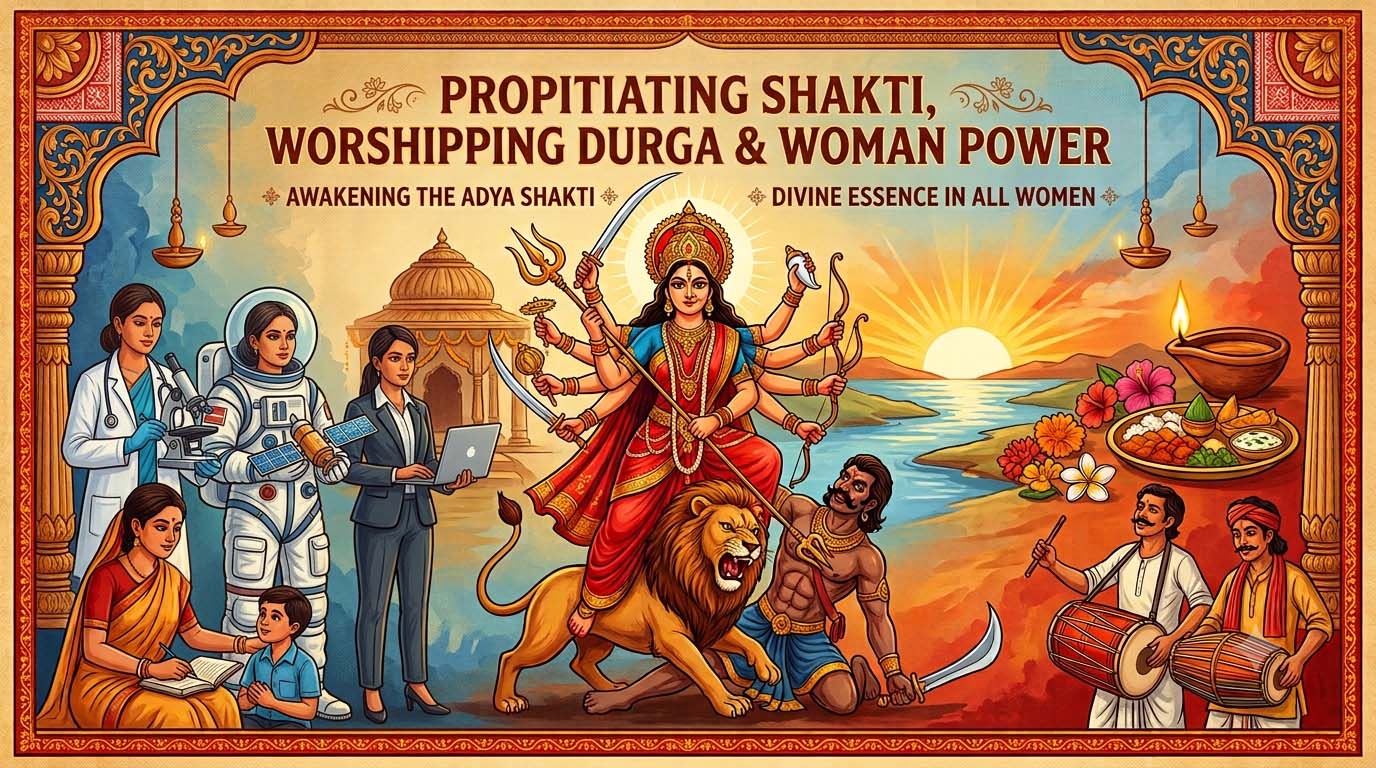
Goddess Durga is symbolized as a power of woman. In contemporary India, worshipping Durga has become part of tradition in India through vedic rules in a specified period. Woman is one of the greatest creations in the earth. The theory of woman and its’ existence is signified by the hidden energy that woman possess. The energy is woman is unparallel and incomparable. It cannot be compared with any living being. The concept of fertility cult is associated with woman. It exist the mechanism of procreation which is unique, which differs from man. The physical structure of woman is created in such a way that include the entire process of zygote formation, its’ growth, nourishment and development of a full human body. The entire process of fertilization in the womb of mother reflects the extreme power of woman. In religious doctrine, it is believed that god creates human being. The creation power of woman takes them to the level of goddess, an unbelievable creation of nature. However, the power of women is neglected and underestimated in the male dominated contemporary societies. Such neglect is going on since time immemorial. Their counterpart man has always viewing them in a different zone. Most of them cannot realize the power and energy of woman. It is really unfortunate. The mythological context reveals that such power is realized by the super creator god and deities; but not realized by the men who are sharing the same space and time, as co-habitants. The power of woman is highlighted when there is growth of evil power. In the mythological texts, it is narrated, there was rise of evil power and negative energy in this earth from time to time with a different mission and objectives. They possessed extraordinary powers through which they created havoc and life miserable in the earth. To subjugate such power, almighty god took birth in various names and destroys such powers. The narratives of Dasaavatara of Lord Bishu reflect how he destroyed such evil power from time to time in different forms and names. Such narrative also testifies that in certain period of time frame, some evil powers became more powerful, it is difficult to control such immense power. Such evil powers generated more energy by meditation at different levels. Their uncontrolled power and energy was a serious matter of concern of all gods and deities. The creation of goddess Durga was mainly associated with the neutralizing and dominating the power of Mahishasur, as asserted in mythology. The Buffalo demon, Mahisasur became extremely powerful, and he was totally out of control by any other forces. He had been creating serious damage in triloks (swarga, mortya and patal), and turning life miserable. The deities and gods had no options, apart from invoking power of woman, in the form of Durga, the supreme form of divine energy, providing all the lethal arms of deities and gods; and request to demolish the buffalo demon, in one way or the other. The question is why ‘woman’ energy is invoked and arisen? Why not a male god is created to accomplish the task? The supreme creator god also knows about the potential and hidden divine power of woman, which is not found in man. In mythology, it is said that god Rama also worship Durga as Basanti while he was leading to destroy Ravana, the demon King, who abducted Sita and confined in his custody. It is interesting to note that goddess Durga is known by various names in different region: Jagadhatri, Basanti, Baisnudevi, Uma, Sati, Shakti, Katyani, Kalratri, Siddhidatri, Sailaputri, Kushmandha, Skandhamata, Brahmasarini, Durgatinasini, Serawali and many. There are many other names, few people aware of it. Goddess Durga is worshipped as a symbol of pure positive energy. However, Durga also possesses all the elements through which she can destroy any sort of negative energy. Durga has a great impact in the religious world view of the country, though, the society has been maintaining binary opposition, while woman, the supreme form of energy is neglected. The ancient Indian society did not give priorities of woman education, they always looked for male child as their successor, framed customs of child marriage, satidah, but the same society always maintained the faith on shakti, the divine power of woman and worshipped. Interestingly, the same society and also contemporary society use the various names of Durga, as the name for the daughters. The names such as Aadya, Aarya, Adrija, Oisini, Anika, Anaita, Aparajita, Aparna, Bharabi, Bhargavi, Bhabani, Bhubneswari, Dakshyani, etc are still found in the present Indian society. People use the various names of Durga, but a section of people has not changed their mindset towards women. Earlier evil practices are abolished by different laws from time to time, but crime against woman is still going on in the country. Dowry death, witch hunting is still reported.
In the contemporary age, woman and man are marching together. But a section of people are still remaining ignorant of divine power of woman. There is a long period from prehistoric period to contemporary period. Propitiating sakti was held during prehistoric period and also going on in the contemporary age. The terracotta objects of Neolithic period testify the worship of mother goddess as fertility cult. There are more evidences from Harappa civilization. There are narratives on Shakti as Devi Suktam in Rig Veda. There are some evidences as statue of stone depicting Durga slaying buffalo demon, found from Mathura and Rajasthan. Such evidences show that worshipping sakti was prevalent since time immemorial. The presence of various sakti piths across the country and also in neighbouring countries reveals in continuity. There is interesting mythological narration of the creation of such piths. Lord Bishu dissected the dead body of Sati into several parts. It has done to save the Bishabrahmanda from the anger of Lord Siva, who began ferocious dance, referred as tandava nritya, carrying the body, who embrace death due to insult of her husband Siva by her father Dakhya, in front of all the august gathering. There was creation of a sakti pith in all the places where parts of her body and ornaments fell. These piths become major destination of religious tourism. Some of them include Kamakhya temple of Assam, Kalighat temple of Kolkata, Jalamukhi temple of Himachal Pradesh, Kamakhi Amman temple of Tamilnadu, Mangola Gauri temple of Bihar, etc. Presence of these temples reflects the reality of mythology. In Indian contexts, Durga puja was family centric affair prior to colonial period. The sophisticated landlord, Jamindars organized such puja at family level in Bengal. Report reveals that Lakshikanta Majumdar of Swabarna Roy Choudhury family organized Durga puja at family level in 1610. The rich families showed their status and position by organizing such puja. The community level worship started later on. It started as an expression of devotion towards shakti worship. It is revealed that the first community level puja was held at Guptipara village of Hoogly district of West Bengal. The puja was known as Baroyari puja, held at the last part of 18th century. There is significance regarding this name. The jamindar of this village organized puja at the family level. Twelve locals of the village tried to participate in the puja. They were obstructed in the gate. With anger, and also as revenge, they looted money from the rich people of their localities and organized the first puja. At present, in West Bengal, there are more than 65,000 puja held at community level. Durga puja is also held in several other parts of the country such as Bihar, Uttar Pradesh, Jharkhand, Orissa, Assam, etc. There is a long history of Durga puja celebration in Assam. The Kalika Puran reveals the tradition of Durga puja at Kamakhya and Mahamaya pith prior to seventh century. In 1496, Biswa Singha, the Koch king organized Durga puja. During 16th century, Naranarayan started the tradition of worshipping Durga by making clay idol. Later on the community level puja became popular under the patronage of Pratap Singha, the Ahom King. At present, Durga puja is organized at the nook and corner of Assam at the family as well as community level, and turning as a major festival of Assam. Goddess Durga is appeased by sacrifices of domesticated animals in various shakti pith, temples and shrines such as Kamakhya, Ugratara, Bilbeswar, Buri Gosani thaan, etc. It seems that people are aware of the significance of propitiating shakti. They also aware of the power and energy of woman, but still they maintain a different outlook on women. Propitiating shakti will be fruitful if we change out mindset and outlook towards woman.
End Notes
1. See Shakti: the power of Feminine, asiasociety.org, accessed on 5th October, 2026 at 3.55 pm
2. ibid 1
Selected Readings
David R Kinsley (1986), Hindu Goddess: Visions of the Divine Feminine in the Hindu Religious Tradition, Berkeley: University of California Press, p.133