

Dr. Bhupendra Kumar Sullere
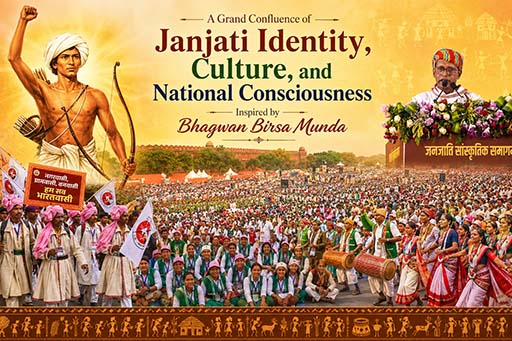
India’s Janjati tradition is not merely the identity of a social group; it represents one of the oldest living streams of Indian civilization and culture. With the objective of preserving and promoting this rich heritage, faith, traditions, and tribal identity, the Janjati Sanskritik Samagam was organized on 24 May 2026 at the Red Fort Ground, Delhi. The event, organized by the Janjati Suraksha Manch and Janjati Jagruti Samiti, emerged as a historic and inspiring gathering.
The program commenced with floral tributes and the ceremonial lighting of a lamp before the portrait of Bhagwan Birsa Munda. Thousands of Janjati representatives from different states of India participated in the event, showcasing their traditional attire, folk dances, songs, and cultural performances, presenting a magnificent picture of India’s unity in diversity. The venue reflected the vibrant colors and spirit of tribal culture.
Birsa Munda: Symbol of Struggle, Self-Respect, and Cultural Awakening
Speakers highlighted that Bhagwan Birsa Munda was not merely a Janjati hero but one of the great icons of India’s freedom movement. He championed the protection of water, forests, and land while promoting cultural self-respect and collective pride. Through his resistance against colonial rule and cultural renaissance, he instilled confidence and self-awareness among tribal communities. His life continues to inspire generations.
Janjati Culture as the Foundation of National Unity
Presiding over the event, Shri Ganesh Ram Bhagat stated that understanding India’s cultural identity requires understanding the way of life of Janjati communities. He emphasized that Janjati society has played a vital role in preserving harmony with nature, family values, community life, and traditional customs. Protecting tribal culture, he said, is a national responsibility in the present era.
Protecting Cultural Heritage: A Need of the Time
Dr. Rajkishore Hansda observed that Janjati traditions are the outcome of centuries of collective wisdom and experience. If these values are neglected in the name of modernization, society risks losing its roots. He urged tribal youth to preserve and promote their languages, folk arts, literature, and traditions.
Janjati Communities: An Integral Part of National Life
Satyendra Singh Kharwar remarked that tribal communities have always remained dedicated to national interests. From the freedom struggle to safeguarding the nation’s borders, their contribution has been significant and inspiring. He stressed the need to integrate Janjati culture into the national mainstream while preserving its original character.
Development and Culture Must Progress Together
Harsh Chauhan stated that development should not come at the cost of cultural identity. While Janjati regions must receive better opportunities in education, healthcare, and employment, equal importance must be given to preserving their traditions and values. Cultural confidence, he said, is essential for holistic development.
The Vital Role of Janjati Women
Budhri Tati highlighted the crucial role of women in preserving family values, culture, and traditions. She called upon Janjati women to actively participate in campaigns aimed at social awareness and cultural conservation.
Cultural Unity from the Northeast to Southern India
Techi Gubin noted that Janjati communities in Arunachal Pradesh and the Northeast have successfully preserved their traditions while contributing actively to national life. Similarly, Hira Kumar Nagu discussed the cultural distinctiveness of Janjati communities in South India, emphasizing that despite geographical distances, the fundamental values of Janjati societies across India remain remarkably similar.
Message from the Chief Guest
The Chief Guest, Shri Amit Shah, Union Home Minister of India, addressed concerns and misconceptions being spread regarding the Uniform Civil Code (UCC). He stated that certain groups, for political and ideological reasons, are creating unnecessary apprehensions about the UCC, whereas its objective is neither to undermine any community, tradition, nor Janjati identity.
He clarified that the unique customs, traditions, and social systems of Janjati communities have always been respected in accordance with the spirit of the Constitution and will continue to be respected. The purpose of the UCC, he explained, is to ensure equal justice for all citizens and not to interfere with cultural identities or religious beliefs.
Shri Shah further stated that attempts are being made to mislead Janjati communities in the name of the UCC. In reality, the government remains committed to the protection and promotion of Janjati languages, culture, traditions, and rights. He urged people not to be influenced by rumours and misinformation but to form opinions based on facts.
Referring to Bhagwan Birsa Munda, he said that Birsa Munda inspired society to follow the path of awareness, self-respect, and truth. Today, Janjati communities should draw inspiration from those ideals while safeguarding their cultural heritage and actively participating in India’s development journey. He expressed confidence that an aware and organized Janjati society would play a significant role in strengthening the nation’s unity, integrity, and cultural prosperity. He also highlighted various government initiatives focused on education, healthcare, skill development, and cultural preservation for Janjati communities.
Cultural Performances Captivated the Audience
Prior to the public gathering, Janjati artists from different states presented traditional dances, songs, indigenous musical instruments, and folk art performances. These presentations beautifully reflected the richness and vitality of India’s Janjati heritage and received enthusiastic appreciation from the audience.
The Janjati Sanskritik Samagam at the Red Fort Ground, Delhi, was not merely a cultural event; it was a grand celebration of Janjati faith, traditions, cultural identity, and national consciousness. Inspired by the legacy of Bhagwan Birsa Munda, the gathering conveyed a powerful message that India’s cultural strength lies in its diversity, and tribal communities form one of its strongest foundations. The preservation of Janjati culture is not only the responsibility of Janjati society but of the entire nation.