

Dr. Bhupendra Kumar Sullere
Even today, when the first rays of the rising sun illuminate the majestic peaks of the Himalayas, when the sacred waters of the Ganga whisper the timeless message of Sanatana Dharma, and when the resonating sounds of temple bells and Vedic chants fill the air with divinity, it feels as though a powerful voice still echoes through the soul of India:
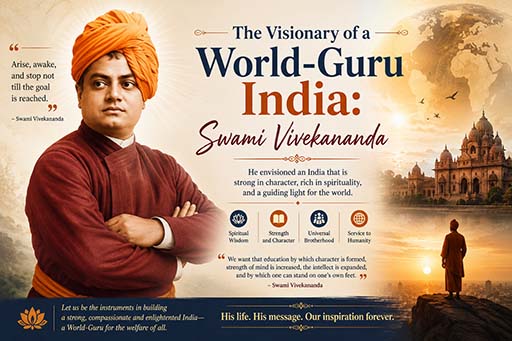
"Arise, awake, and stop not till the goal is reached."
These are not merely inspiring words; they are the clarion call of India's spiritual renaissance. They belong to the visionary who awakened a nation burdened by self-doubt, restored its confidence, and introduced the universal philosophy of Sanatana Dharma to the world. Through his life and teachings, humanity came to recognize the profound spiritual heritage of India. That visionary was Swami Vivekananda.
July 4 is not merely a date on the calendar; it is a sacred milestone in India's spiritual history. On this day in 1902, at the holy grounds of Belur Math, Swami Vivekananda consciously entered Mahasamadhi, leaving behind his mortal body through the power of deep yogic realization. He lived for only thirty-nine years, yet those years illuminated the path of India and the world with an eternal flame of wisdom. His physical form merged with the five elements of nature, but his thoughts continue to inspire generations across the globe.
Swami Vivekananda's life was far more than the journey of a monk; it was the awakening of India's national soul. At a time when the country was struggling under colonial rule, social stagnation, and a loss of self-confidence, he reminded every Indian of their true identity. He firmly believed that India had never been poor in spirit or weak in character. Its greatest wealth lay in its spirituality, knowledge, and the eternal values of Sanatana Dharma. Once Indians rediscovered their inner strength, he believed, no power on earth could defeat them.
He presented Sanatana Dharma not as a narrow religious identity but as the eternal philosophy of life. To him, "Sanatana" meant that which is beginningless, endless, and universally relevant. It is not confined to a single prophet, one holy book, or one path of worship. Rather, it is the eternal quest for truth, the pursuit of self-realization, the practice of tolerance, and the vision of the entire human race as one family.
His historic address at the World's Parliament of Religions was not merely India's triumph; it was the triumph of a civilization that embraced harmony among all faiths. He declared before the world that India had never sought to conquer religions but had always welcomed and respected them. This spirit of unity in diversity remains one of the greatest strengths of Sanatana Dharma.
Swami Vivekananda offered a timeless interpretation of God. He taught that God is not confined to temples, churches, mosques, or any particular place of worship. God resides in every living being. Serving the poor, the suffering, the marginalized, and the helpless is the highest form of worship. His celebrated ideal of "Service to man is service to God" continues to define the true essence of spirituality.
According to him, God is Truth, Love, Compassion, Consciousness, Knowledge, and the Divine Power present within every soul. The purpose of life is not to search for God outside but to awaken the divinity that already exists within. Every soul, he affirmed, is potentially divine, and the goal of life is to manifest that divinity through selfless action, knowledge, devotion, and meditation.
Swami Vivekananda saw no conflict between religion and science. Instead, he believed that they complement one another. Science explores the external universe, while spirituality investigates the inner universe of human consciousness. Religion, he argued, does not oppose reason; rather, it encourages rational inquiry in the search for truth. This balanced vision makes his philosophy remarkably relevant even in the modern scientific age.
He also redefined the meaning of education. Education, according to him, is not merely about passing examinations or securing employment. Its true purpose is to awaken the infinite potential already present within every individual. Real education builds character, strengthens self-confidence, inspires patriotism, and nurtures self-reliance. Only men and women of character, he believed, can build a truly great nation.
His faith in the youth was extraordinary. He famously declared that if he could find just a hundred energetic, fearless, and dedicated young men and women, he could transform India. He urged young people to cultivate courage, discipline, perseverance, and an unwavering commitment to national service. His own life stands as living proof that inspired youth possess the power to change history.
Swami Vivekananda firmly believed that India's greatest contribution to the world would not merely be economic prosperity but moral and spiritual leadership. India, he maintained, would become a true Vishwaguru only by living the eternal values of truth, service, sacrifice, compassion, tolerance, and self-discipline embodied in Sanatana Dharma.
Today's world, despite unprecedented technological advancement, continues to face crises of mental stress, violence, materialism, environmental degradation, and moral decline. In such times, Vivekananda's message is more relevant than ever. He reminds humanity that scientific progress must be guided by wisdom, prosperity must be accompanied by compassion, and power must always be rooted in character.
India's youth today are making remarkable achievements in technology, entrepreneurship, science, sports, education, and global leadership. If this dynamic energy is combined with Swami Vivekananda's ideals of self-confidence, patriotism, and spiritual vision, India can emerge not only as an economic superpower but also as a moral and cultural leader of the world.
Swami Vivekananda belongs to no single organization, sect, or ideology. He belongs to all humanity. His life teaches that the highest religion is the service of mankind, the greatest worship is selfless action, the greatest strength is unwavering self-confidence, and the noblest purpose of life is dedicated service to the nation and humanity.
On his Mahasamadhi Day, the truest tribute we can offer is not merely through floral homage but by living his ideals. As long as an Indian youth rises with confidence to pursue a noble goal, as long as a human being serves another with compassion, and as long as the eternal values of truth, service, and Sanatana Dharma continue to inspire humanity, Swami Vivekananda will remain immortal—not only in the pages of history but in the very soul of India and in the conscience of the world.